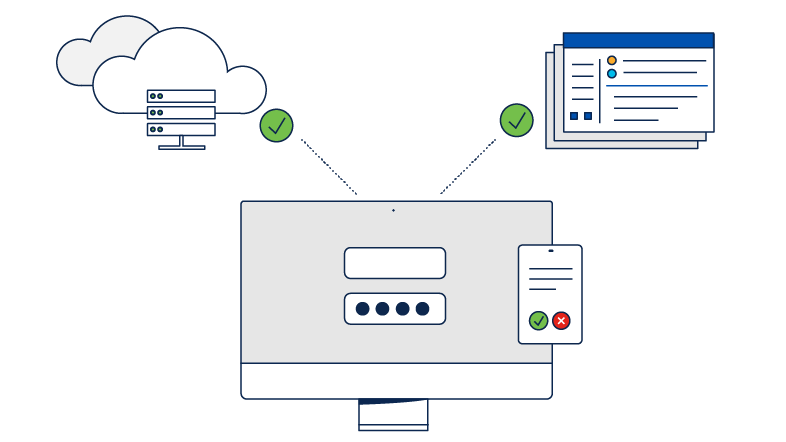
Graphic that depicts secure remote access

What is secure remote access?

Secure remote access is the practice of providing controlled, authenticated, and continuously verified access to organizational resources for users working off the corporate network.  

Modern secure remote access spans three approaches: traditional VPN, zero-trust network access (ZTNA), and secure access service edge (SASE) - each with different trade-offs in coverage, user experience, and operational model.  

The category aligns with zero-trust principles and supports a distributed workforce that accesses applications across cloud, hybrid, and on-premises environments. The U.S. National Institute of Standards and Technology (NIST) provides foundational guidance for secure remote access in NIST SP 800-46, with NIST SP 800-207 (Zero Trust Architecture) supporting the modern ZTNA-aligned approach.  

What is secure remote access and why is it important?

Secure remote access for employees allows authorized users to connect to their corporate network on authorized devices from remote locations. The goal is to prevent unauthorized access, protect data confidentiality, and preserve the integrity of the devices and resources users connect to.  

Secure remote access has shifted from a feature for a few remote employees to a requirement for organizations of all sizes. Bring-your-own-device (BYOD) policies, hybrid work, and the growth of cloud-hosted applications have expanded the attack surface significantly - more users access sensitive resources from more locations on more devices than ever before. Each new access point is a potential entry for attackers, which makes the controls that secure remote connections a foundational part of enterprise security. 

What are the security risks of remote access?

Remote access introduces several distinct risk categories. Each has a different attack pattern and a different control set.  

  • VPN risks. Traditional virtual private networks (VPNs) encrypt the user's connection to the network, but they grant broad network access once authenticated. Without strong policy controls layered on top, VPN access becomes a high-value target - attackers who compromise VPN credentials gain wide access to the corporate network.  
  • Expanded attack surface. As organizations allow more devices and connections to access the network remotely, the number of potential entry points grows. Each new device and access point increases the surface attackers can target.  
  • Human error. Employees with limited security training make mistakes - failing to update devices, ignoring corporate security policy, or falling for phishing attempts. These errors can result in network breaches or data exposure.  
  • Phishing and malware. Attackers exploit remote access through phishing emails and malware attachments. A user who clicks a deceptive link or downloads a malicious file gives attackers a foothold in the corporate network.  
  • Privileged access vulnerabilities. Power users (administrators, IT engineers, executives) hold privileged access to critical systems and data. If their remote connections are not protected with strong authentication and continuous verification, attackers who compromise privileged accounts can gain wide access to sensitive systems.  

How do I secure my device for remote access?

Securing a device for remote access is the foundation of a secure remote connection. The five practices below apply to every device used to access corporate resources off the network: 

  • Keep devices up to date with security patches and operating system updates. 
  • Use strong, unique passwords - and avoid reusing them across services. 
  • Avoid public Wi-Fi for sensitive work; use a corporate VPN or a trusted network where possible. 
  • Enable multi-factor authentication (MFA) for all corporate accounts. 
  • Maintain device security hygiene - endpoint security software, encrypted storage, screen lock policies - to ensure only healthy devices connect to corporate resources.  

How does secure remote access work?

Secure remote access works by combining four controls that verify users, devices, and connections continuously - not just at the moment of login.  

  • Granular, role-based access policies. Before users connect, administrators define access policies that determine who can access what. Users receive access only to the specific resources their roles require. If a user's account is compromised, the attacker can only reach the resources the compromised user was authorized to access - limiting the blast radius of the breach.  
  • Strong authentication. Secure remote access requires more than a password. Multi-factor authentication (MFA) requires users to verify their identity with a combination of factors - a password plus a one-time code, a hardware token, a biometric scan, or a push approval - before access is granted.  
  • Secure remote access VPN. Modern VPNs designed for zero-trust network access (ZTNA) replace traditional VPN's broad network access with granular, application-specific access. Users authenticate, the system verifies device posture and context, and the VPN grants access only to the specific applications the user is authorized to reach.  
  • Endpoint session monitoring. Tools such as security service edge (SSE) and extended detection and response (XDR) monitor user and device behavior continuously during the session. Anomalies - unusual data access, activity from a new location, or behavior that diverges from baseline - trigger additional verification, alerts, or session termination.  

VPN vs ZTNA vs SASE-delivered remote access 

Modern secure remote access can be delivered three ways. Each has different trade-offs in coverage, user experience, and the architectural shift required to deploy. 


Approach What it providesBest fitKey limitation
Traditional VPN Encrypted tunnel from user device to corporate network; broad network access once authenticatedLegacy environments and use cases requiring full network accessBroad access once authenticated; concentrator scaling limits; user friction at sign-in
ZTNA (Zero Trust Network Access)Identity-and-context-verified access to specific applications; continuous verificationModern application-centric access; reducing lateral movement riskRequires identity infrastructure and policy framework
SASE-delivered remote accessZTNA plus secure web gateway (SWG), cloud access security broker (CASB), firewall as a service (FWaaS), and SD-WAN delivered as a cloud serviceDistributed workforce; consolidating networking and security Larger architectural shift; vendor consolidation decisions

The three approaches are not mutually exclusive. Many organizations operate VPN and ZTNA in parallel during transition, with SASE adoption following as networking and security architecture consolidates. The right choice depends on existing infrastructure, identity readiness, and the specific use cases secure remote access must support.  

Is remote access more secure than VPN?

Modern secure remote access solutions provide stronger security than traditional VPN alone. VPNs create an encrypted tunnel for data transmission - an important control - but they do not by themselves enforce zero-trust principles, granular access control, device posture verification, or continuous session monitoring. Modern secure remote access combines VPN-style encryption with zero-trust policy enforcement, multi-factor authentication, device health checks, endpoint visibility, and continuous monitoring. The result is a layered approach that protects against the threats VPN alone cannot - including credential theft, session hijacking, lateral movement after breach, and access from compromised devices. 

What is the safest way for remote access?

The safest approach to remote access combines several security tools and practices, layered together: 

  • Encrypted connections through a secure remote access VPN or ZTNA tunnel 
  • Strong authentication with MFA and single sign-on (SSO) 
  • Continuously updated security policy aligned with zero-trust principles 
  • Endpoint security software that verifies device health before granting access
  • Cloud-delivered security services through SSE or SASE No single tool delivers complete remote access security 

The combination - strong authentication, granular access policy, continuous monitoring, device posture verification, and integration with broader identity and security infrastructure - is what makes a secure remote access program effective.  

Solution

Cisco Secure Access

Safeguard your remote and hybrid workforce with cloud-delivered zero-trust security.

Solution

Remote access integrations with Cisco Duo

Duo's modern remote access protects every application, so your users can continue working with the tools they love.

Solution

Cisco Secure Equipment Access

Control remote access to your industrial assets and protect operations with zero-trust remote access that's made for OT workflows.

What are secure remote access solutions?  

Secure remote access is enabled by a combination of technologies. The strongest remote access programs evaluate solutions across authentication, encryption, access control, monitoring, and endpoint protection.  

Multi-factor authentication (MFA)  

MFA enhances security by requiring users to provide two or more independent factors of identity verification before granting access to corporate applications. Even if one credential is compromised, additional authentication factors stand in the way of an attacker.  

Single sign-on (SSO)  

SSO allows users to access multiple applications with a single set of credentials. SSO works alongside MFA to simplify user experience while reducing password-related breaches.  

Endpoint security 

Endpoint security uses solutions such as endpoint detection and response (EDR) and extended detection and response (XDR) to protect devices connecting to the network. EDR monitors endpoints for malicious activity; XDR correlates threat data across endpoints, networks, clouds, and applications for broader detection coverage.  

Secure remote access VPN  

VPNs protect connections between remote users and the corporate network through strong authentication and encryption. Modern VPNs aligned with ZTNA principles provide application-specific access rather than broad network access - limiting exposure if a user's credentials are compromised.  

Security service edge (SSE)  

SSE delivers cloud-based security services including secure web gateway (SWG), cloud access security broker (CASB), firewall as a service (FWaaS), zero-trust network access (ZTNA), DNS security, and remote browser isolation (RBI). SSE consolidates these capabilities in a single cloud service with centralized policy and management.  

Network access control (NAC)  

NAC systems determine which devices and users can connect to a network - and to what extent. NAC tools assess device health, enforce access policy, block unhealthy devices from connecting, and continuously verify user behavior to maintain network security.  

Secure access service edge (SASE)  

SASE is an architecture that converges networking and security as cloud-delivered services. SASE includes SD-WAN, ZTNA, SWG, CASB, FWaaS, and other security functions in a unified cloud platform.  
Common questions about secure remote access

Secure remote access is the practice of providing controlled, authenticated, and continuously verified access to organizational resources for users working off the corporate network. Modern approaches include VPN, zero-trust network access (ZTNA), and secure access service edge (SASE). The category aligns with zero-trust principles and supports a distributed workforce.

A VPN provides broad network access once a user authenticates - once connected, the user can typically reach much of the corporate network. ZTNA provides per-application access with continuous verification - users access only the specific applications they are authorized for, and access is verified on every request. ZTNA reduces the blast radius of a compromised credential significantly compared to traditional VPN.

The main risks are VPN over-trust (broad access once authenticated), expanded attack surface from more devices and access points, human error, phishing and malware delivered through remote workers, and privileged access compromise. Each risk requires different controls - VPN over-trust calls for ZTNA; phishing calls for MFA and email security; privileged access calls for granular policy and monitoring. 

SASE converges networking and security as cloud-delivered services, including ZTNA, SWG, CASB, and FWaaS in a unified platform. For remote access specifically, SASE delivers consistent security policy across all users regardless of location, replaces VPN concentrator scaling with cloud-scale capacity, and integrates remote access security with broader networking decisions.

Look for strong authentication (MFA), granular per-application access control, continuous device posture verification, integration with existing identity infrastructure, and continuous session monitoring. The right solution should align with zero-trust principles, support the cloud applications your workforce actually uses, and integrate with your existing endpoint security and identity management. 


Related security solutions

What is zero trust network access (ZTNA)?

Zero Trust Network Access (ZTNA) verifies users and grants access to specific applications based on identity and context policies.

What is endpoint security?

Endpoint security protects network-connected devices, like mobile devices, desktops, and laptops.

What is a virtual private network (VPN)?

A virtual private network, or VPN, is an encrypted connection over the Internet from a device to a network.

What is extended detection and response (XDR)?

XDR provides visibility and threat remediation across networks, clouds, endpoints, and applications.

What is multi-factor authentication (MFA)?

MFA is a security measure that goes beyond a password to verify a user's identity.

What is single sign-on (SSO)?

Single sign-on provides users with an easy and consistent login experience for every application.

E-book

The Essential Guide to Securing Remote Access

This guide looks at the threats facing remote access users, devices, and services, and provides insights on how to secure remote access through a layered zero-trust security approach.